Low Qualification
Highest Pay With No Skills: Jobs That Pay Big From Day One
12 min read · August 13, 2026
Car sales, real estate, mining labour, lawn rounds and pressure washing can pay serious money without a degree, a trade ticket or years of training.

What "no skills" really means in the pay market
When people search for the highest paying jobs with no skills, they are almost never asking for work that requires nothing at all. What they are actually asking is: which jobs will hire me this month, without a degree, without a four year apprenticeship and without a stack of certificates, and still pay me well enough to change my financial position quickly? That is a very different question, and it has good answers.
The pay market does not reward credentials for their own sake. It rewards three things: scarcity, risk and results. A credential is simply one way to prove scarcity. If you can prove it another way — by being willing to work where others will not, by turning up reliably, or by producing measurable sales — the market will pay you without ever asking to see a piece of paper.
Every role in this article shares one feature: the barrier to entry is behaviour rather than education. You can start most of them within two to six weeks of deciding to. What separates the person earning a modest wage from the person earning a very large one in the same role is almost always effort, hours and a willingness to be uncomfortable.
Commission car sales: the classic day-one earner
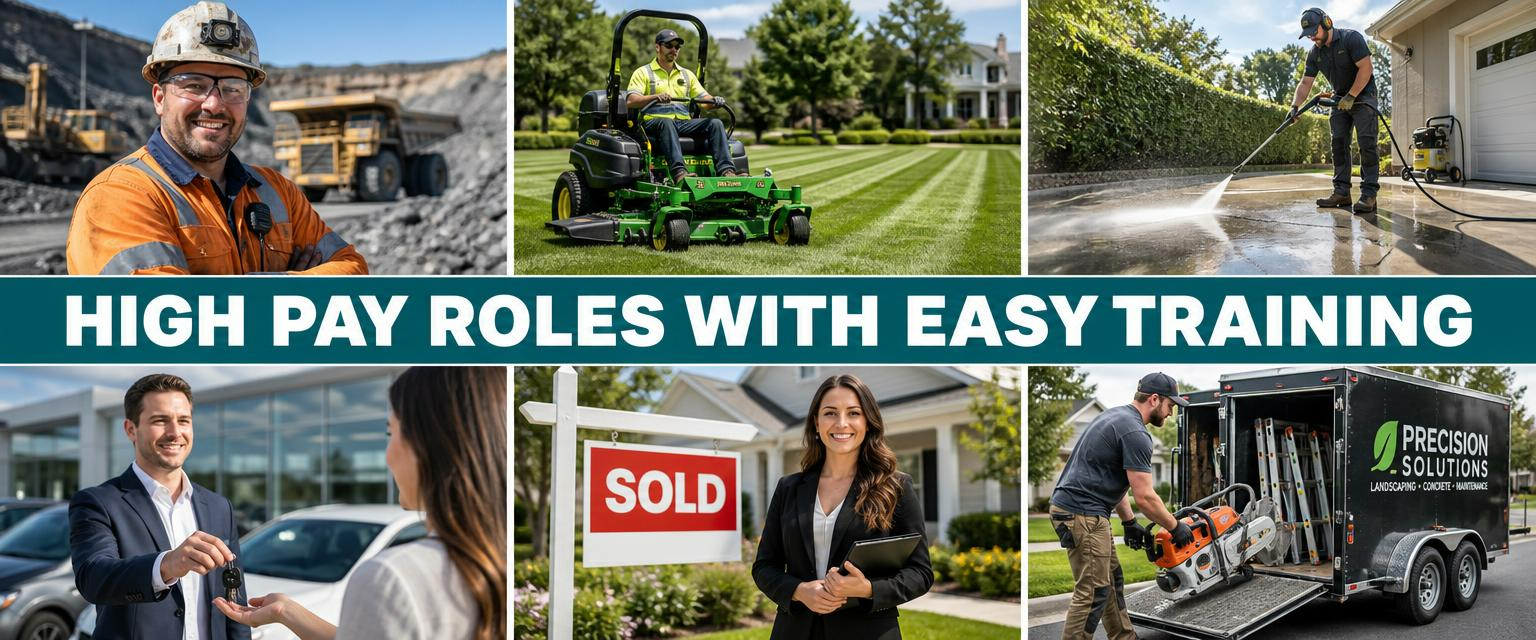
Car sales remains one of the few jobs on earth where a motivated person with no qualifications at all can out-earn university graduates within twelve months. Dealerships hire on personality, energy and persistence, and they train you on the product in-house. Most pay a modest retainer plus commission per unit, with escalating bonuses once you pass monthly volume targets.
The economics are simple. A salesperson who moves eight cars a month earns a living. One who moves eighteen, adds finance, insurance, paint protection and extended warranty to a decent share of those deals, and works the Saturday and Sunday traffic that others avoid, earns a multiple of it. The product is identical; the income is not.
The trade-off is honest and worth stating: income is variable, weekends are working days, and slow months hurt. Anyone entering commission sales should negotiate the highest retainer they can while learning, and should treat the first ninety days as unpaid education that happens to come with a small wage.
Real estate sales: the highest ceiling in low-qualification work
Residential and commercial property sales sit near the very top of the no-degree pay league. In most jurisdictions the entry requirement is a short licensing or registration course measured in days or weeks, not years, followed by work under a licensed agency. Nothing about that course teaches you to sell; it teaches you the legal rules.
Agent income is a percentage of a very large number. Because commissions are calculated on sale prices, a single transaction can generate more gross commission than a month of most salaried jobs. Agents who build a defined territory, farm it consistently for years and become the obvious first call in that postcode reach income levels that surprise people outside the industry.
The catch is the ramp. Most new agents earn very little for the first six to twelve months while a pipeline is built, and many leave inside two years for exactly that reason. Treat the first year as a runway problem: have savings or part-time income, and judge progress by appraisals booked and listings won rather than by commission banked.
Mining, resources and heavy industry labour
Resource work is the fastest way for an unqualified person to reach a high annual wage. Entry-level roles — trade assistant, plant washdown, drill offsider, process operator, general labour hand — typically require a basic safety induction, a medical, a driver's licence and a clean drug and alcohol test. Site inductions and tickets for confined space, working at heights or elevated work platforms are short courses often paid for by the employer or recouped in days.
Pay is high for three reasons: the work is remote, the rosters are punishing, and the industry cannot function without bodies on site. Fly-in fly-out and drive-in drive-out arrangements add camp accommodation, flights and messing, which means a large share of gross pay can be saved rather than spent on rent and groceries. Overtime, night shift loading and site allowances routinely lift take-home well beyond the base rate.
The real skill in resources work is not technical, it is behavioural: pass every test, never miss a shift, follow safety procedure exactly, and be the person supervisors want back next swing. Do that for two years and you will be offered tickets, plant operation and eventually supervision — each a further step up in pay, still without a degree.
Lawn mowing rounds: a business you can start on a Saturday
A mowing round is one of the purest examples of income without qualification. The equipment is a mower, a line trimmer, a blower and a trailer. The skill takes an afternoon to learn. The difference between a hobby and a serious income is entirely in how the round is built.
The economics turn on density and repetition. Twenty lawns spread across a city is a bad business because you spend the day driving. Twenty lawns in four adjoining streets, cut on a fixed fortnightly cycle, is a very good one, because travel time collapses and every hour becomes billable. Operators who deliberately cluster their clients, quote per job rather than per hour and pre-book the next visit before leaving the driveway earn far more per day than those who chase random one-off jobs.
The upgrade path is obvious once the round is full: add hedging, garden clean-ups, green waste removal, gutter clearing and holiday-home maintenance to the same customers, then put a second operator in a second vehicle. At that point you have stopped selling your hours and started selling someone else's, which is the same mechanism that lifts trades businesses far above trade wages.
Pressure washing driveways, roofs and commercial hard surfaces
Pressure washing needs no qualification and produces an instantly visible result, which makes it unusually easy to sell. A clean half of a driveway next to a dirty half closes more jobs than any brochure. Startup costs are modest — a commercial-grade petrol washer, a surface cleaner attachment, hoses, water tank and a way to tow them.
Residential driveways, paths and patios are the entry market and are priced per square metre. The larger money sits in commercial and strata work: carparks, shopping centre walkways, service station forecourts, apartment block bin rooms and body-corporate common areas. These clients buy on a schedule, pay on invoice and are worth many times a one-off residential job because they repeat.
Two things separate the high earners: the right equipment, because a surface cleaner does in twenty minutes what a wand does in two hours, and correct handling of water run-off and detergents under local environmental rules. Get both right and a solo operator can bill a full trade rate while operating a machine they learned to use in a weekend.
Rideshare and delivery done as a business, not a hobby
Uber, rideshare and food delivery are widely written off as low-paid gig work, and driven casually that is exactly what they are. Driven strategically they behave very differently, because platform earnings are concentrated into a small number of predictable windows.
The pattern repeats in almost every city: weekday commuter peaks, Friday and Saturday nights, airport arrival waves, major sport and concert finishes, public holidays, and any period of bad weather. During these windows surge multipliers, quest bonuses and streak incentives stack, and an hour can be worth two or three times an off-peak hour. A driver who works only twenty-five well chosen hours a week can out-earn one who drives fifty hours indiscriminately, with far less fuel and vehicle wear.
Run the real numbers before committing. Fuel or charging, insurance, servicing, tyres, cleaning, platform commission and vehicle depreciation all come out of the gross figure the app shows you. Track cost per kilometre honestly, use a fuel-efficient or electric vehicle, and treat the whole thing as a small transport business with a spreadsheet, not as pocket money.
The other high-paying entry roles worth knowing
Beyond the headline options there is a long tail of roles that pay well and ask almost nothing on entry. Traffic control and stop-go work requires a short ticket and pays strong hourly rates with heavy night and weekend loading. Warehouse and distribution work on night shift pays a premium purely for the hours. Oil and gas catering, camp cleaning and camp maintenance carry remote allowances on top of ordinary wages.
Removalists, scaffolder's labourers, concrete crews, demolition hands and roof-tiling offsiders all pay above general labour rates for physical capability and reliability. Security work needs a short licence and pays night and event loadings. Fishing, farm harvest, shearing sheds and abattoirs are seasonal but pay piece rates that reward speed rather than schooling.
In sales, door-to-door energy and telecommunications, solar sales, gym memberships, and business-to-business phone sales all hire on attitude and pay commission that has no ceiling. None of these ask what you studied. All of them ask whether you will still be doing it in six months.
What actually multiplies your pay in these jobs
The people earning the most in low-qualification work are not doing different jobs; they are doing the same job differently. Four levers explain almost all of the gap. The first is hours placement — working the nights, weekends, remote swings and peak windows that others avoid, because that is when the loadings and multipliers live.
The second is measurable output. Anywhere pay is tied to units sold, lawns cut or square metres cleaned rather than to time attended, you control your own income. The third is repeat customers. A one-off job is paid once; a fortnightly customer is paid seventy times over three years for the same acquisition effort.
The fourth, and the largest, is ownership. A mowing employee is paid a wage; a mowing round owner is paid the margin on every operator in the fleet. A commission salesperson is paid on their own deals; a sales manager is paid on the team's. Across the whole JobRank pyramid, the shift from selling your hours to owning the asset is the single biggest jump in income available to someone with no formal qualification.
Going in with your eyes open
High pay without qualifications is real, but it is not free. It is usually paid for in physical wear, unsociable hours, income volatility, time away from home or exposure to weather and risk. Those are genuine costs and should be priced into the decision rather than discovered later.
Protect yourself accordingly. Understand how you are engaged — employee, casual or contractor — because it determines your leave, insurance and tax position. Keep money aside for tax if you are self-employed, insure your equipment and your income, and look after your back and hearing in physical work, because your body is the asset generating the income.
Finally, use the money for something. The reason these jobs are powerful is not the wage itself, it is the head start. Someone earning strongly from age eighteen with no student debt, who saves aggressively for three years and then buys a vehicle, a round, a licence or a first property, ends up far ahead of a peer who spent those years accumulating fees. The qualification was never the point. The compounding was.